

The last photo is usually not a good photo. It is whatever happened to be on your phone: the dog on the sofa, half in shadow, the cat in the window frame, the horse in the stable at dusk. And that very photo suddenly becomes important when your animal is no longer here.
For many people, a memorial picture is a way of giving their animal a lasting place. Not as an altar, not as a mourning corner, but as a picture that goes along with everyday life. So that it comforts you later instead of hurting, it is worth thinking about a few things beforehand: which photo, which style, which words, and where the picture should hang.
When is the right time?
There isn't one. Some people want to hold something in their hands in the first week, because the empty spot in the hallway is almost unbearable. Others need months before they can even look at photos again. Both are normal.
One practical thought helps anyway: back up the photos now. Phones get replaced, cloud storage fills up, chats get deleted. Create a folder and copy in everything you have of your animal, even the blurry pictures. You can decide later.
Which photo works?
The best photo for a memorial picture is not the prettiest one, but the most honest one. The picture in which you instantly recognise your animal: the crooked glance, the one ear that never quite stood up, the markings on the chest.
Technically, three things matter:
- The head is clearly visible. Eyes, ears and muzzle should not be cut off or covered.
- The animal is large enough in the frame. A dog standing as a tiny dot at the far end of a meadow gives too little detail.
- Light from the front or the side. Backlight quickly turns dark fur into a black patch.
A normal phone photo is enough for this. Even a screenshot from a chat or an old post can do, as long as the animal is easy to recognise in it. If you would like to know more, the article Taking dog photos yourself has a few tips that also apply to older photos.
If there are only blurry or old photos
Especially with animals who lived a long time, the best photos often come from a time when phone cameras were still weak. Or there is only a single picture from the last weeks, and it is dark. That is no reason to go without a memorial picture.
Pick the photo in which the head is clearest, even if the rest is not right. Background, lead or an awkward crop can simply be left out. What matters are the features by which you recognise your animal. If you have two photos, one with a good face and one with a typical posture, choose the face. The posture you can tell better with the line on the picture.
Which style suits a memorial picture?
There is no right or wrong here, but one simple question helps: should the picture be calm or lively?
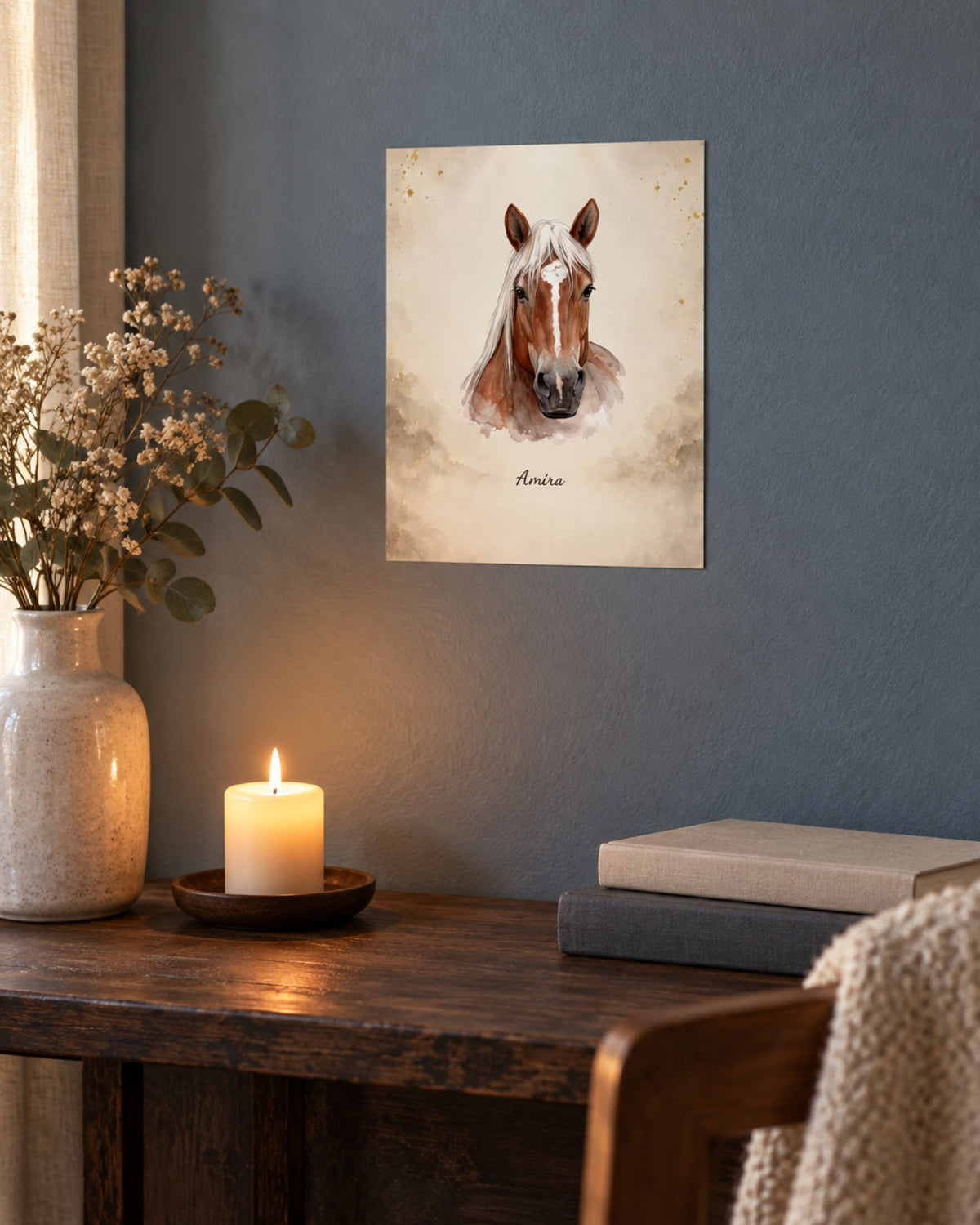
Calm is the effect of soft watercolour tones, plenty of white space and warm colours. Such pictures suit bedrooms, reading corners or places where you pause for a moment. The Tinte & Gold style, for example, works with dark lines, warm light and tiny golden sparks that are reminiscent of stars.

Lively is fine if the animal itself was like that. A dog who came through the door at a run every single day does not have to hang on the wall as a quiet devotional picture. Some people deliberately choose a cheerful style, because that is exactly the memory they want to keep.
A good test: imagine walking past the picture in the morning. Would you like to smile or to pause? Let that decide the style.
Two fixed motifs for remembrance, which we designed especially for saying goodbye: the Memorial Portrait Angel with delicate wings and a gentle halo, and the Memorial Portrait Rainbow Bridge with soft clouds and a glowing rainbow. Both are also available on canvas (Rainbow Bridge) and in a wooden frame (Rainbow Bridge). You upload a photo, add a name and a line if you like, and see the preview before you order.
Name, dates, one sentence: what belongs on the picture
Many people wonder whether there should be any text on the picture at all. A name is almost always a good idea. It makes the picture personal, even for visitors who never knew the animal.
Opinions differ on years. For some they belong, for others they make the picture too much like a gravestone. An alternative is a short sentence that fits the animal. Not the best-known saying from the internet, but something of your own: "Best co-driver in the world", "Always first at the door", "Our sofa king". Sentences like these bring a smile when you read them rather than a lump in your throat.
Less is more here. A name plus one line is enough. Long poems quickly look cramped on a wall picture.
Material and size
A memorial picture should last a long time and look good without dominating. A few pointers:
- Framed poster is the easiest solution and can be reframed later if your furnishings change.
- Canvas feels warmer and needs no frame. It looks good above a sideboard or in the stairwell.
- Wood has its own feel and is often chosen as a memorial picture because it comes across more like a keepsake than decoration. One example is the memorial picture on wood.
- Small and close: a sign with a photo next to the spot where the bowl used to stand can mean more than a large picture in the living room. For this there is, for example, the memorial sign with photo.
As for size: better one size smaller than you spontaneously think. A picture of 30 by 40 centimetres is easy to see at eye level and does not overwhelm the room.
Where the picture should hang
Surprisingly often a memorial picture ends up in a place that has nothing to do with the animal, for example above the dining table, simply because there happened to be space. A place with a connection works better: the hallway where the dog always waited, the windowsill where the cat lay, the stable aisle or the tack room.
It also matters whether you can look away. A picture directly opposite the bed is the first thing you see every morning. For some people that is exactly right, for others it is too much in the first weeks. A place you walk past leaves you the choice.
Giving a memorial picture as a gift
When friends or family have lost their animal, a memorial picture is a gift that says: I know how much this animal meant to you. A few tips:
- Not too soon. In the first days a picture can be overwhelming. A few weeks of distance is often better.
- Check the photo beforehand or choose it yourself. A photo you took of the animal yourself, or a picture from a shared chat, is usually just right, because it shows a shared memory.
- Hand it over quietly. Not at a party in front of everyone, but in a way that lets the person react in peace.
You can find an overview of pictures, signs and small keepsakes under Remembering a pet. For each of these products you see the preview while you design it, before you order.
When a new animal moves in
At some point many people ask whether a new animal is "allowed". A memorial picture can help, because it gives the old animal a lasting place that is not taken away. The new animal is not a replacement, it is an addition.
If you then set out with a puppy or a rescue dog, our books page has two guides that help at the start: on choosing the right breed and on puppy training.
In short
A good memorial picture begins with an honest photo in which you instantly recognise your animal. The style depends on whether you want to smile or pause as you walk past. A name and one line are enough. And the place on the wall should have something to do with the animal.
20 % of our profit goes to animal welfare.


