

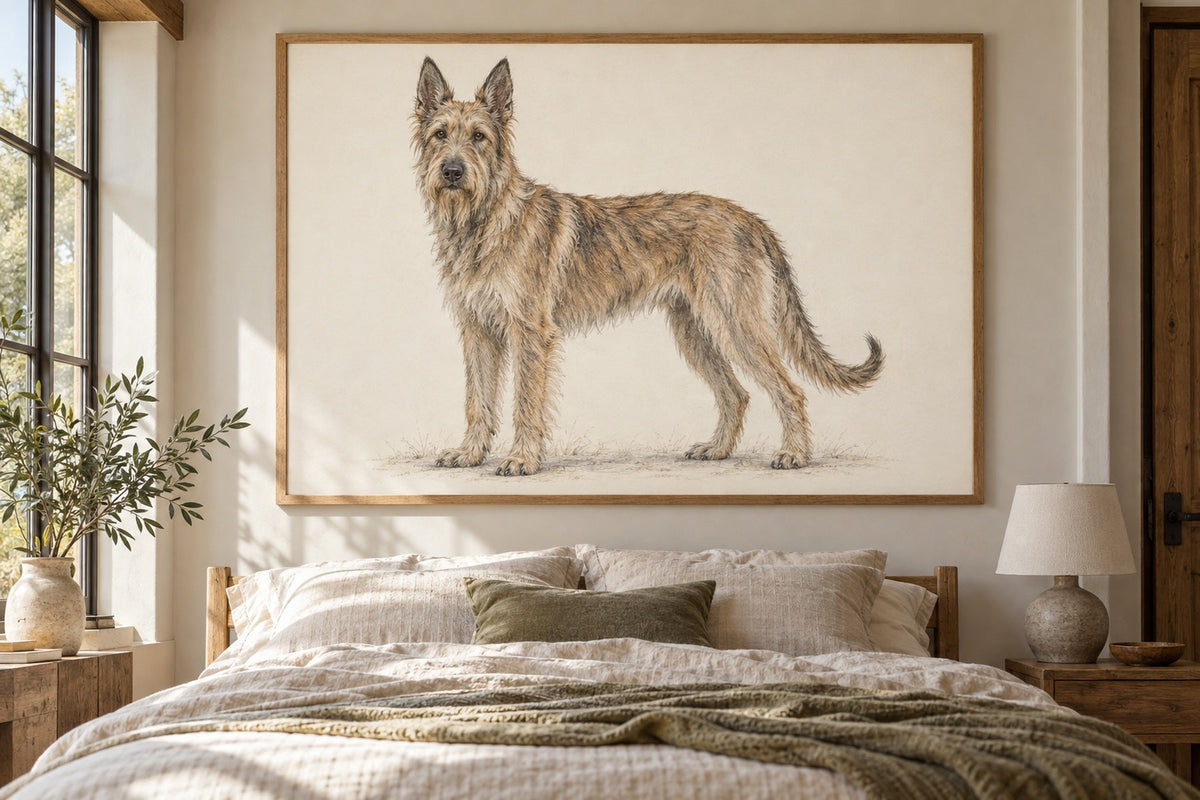
In 1863, they first shared the show ring: Picards, Beaucerons and Briards were judged together. Of the three, the Picardy Sheepdog (Berger de Picardie) has the rough, medium-length hair and natural prick ears. The standard attributes the expression to griffonnage: strong eyebrows, beard and moustache.
| FCI | Group 1 (Sheepdogs and Cattledogs), Section 1 Sheepdogs, Standard No. 176 Berger de Picardie (Picardy Sheepdog), with working trial |
|---|---|
| Country of origin | France |
| Size (height at the withers) | males 60 to 65 cm, females 55 to 60 cm; tolerance of 1 cm above or below |
| Weight | not specified in the FCI standard |
| Life expectancy | no reliable study figure found (N/A) |
| Coat | harsh, medium-length and rough, 5 to 6 cm over the whole body including the tail; fine, dense undercoat |
| Colours in the standard | fawn, fawn with black overlay, brindle fawn and grey, usually remaining dark; a slight white patch on chest and toe tips tolerated |
Older than the name
The standard considers it possible, even likely, that this sheepdog was not confined to Picardy, since rough-coated herding and cattle dogs existed throughout north-western Europe. The breed was considered established in 1898; Paul Mégnin wrote the first standard in 1922, and definitive recognition in France followed in 1925. Breeding stagnated until the Second World War; afterwards, enthusiasts searched Picardy for dogs of similar type. The FCI definitively recognised the breed on 27.06.1955. Find the 1863 show-ring companions in this encyclopedia: the Beauceron and the Briard.
Balanced and fond of children
Balanced, neither aggressive nor fearful or insecure, intelligent and courageous: the standard requires these qualities for herding and guarding sheep. It also calls this a very good house guardian and an excellent family dog who enjoys living closely with children. In daily life, these dogs are affectionate, announce visitors and initially remain watchful towards strangers.
A shepherd who wants to work
The FCI nomenclature requires a working trial for the Picard. Movement should appear supple, free and effortless; the build suits long days outdoors. Plan lengthy daily walks and provide tasks: herding, tracking, obedience or mantrailing. Otherwise, a large dog with little work finds jobs of their own.
It should feel rough
The harsh, medium-length hair dries quickly and holds little dirt. Weekly brushing, more often during shedding, is all it requires. Eyebrows grow to around 4 cm but must not obscure the eyes. The standard does not provide for hind dewclaws.
Keep an eye on hips
No reliable lifespan study is available; McMillan and colleagues’ large UK analysis lists the breed but does not analyse it. In French hip dysplasia X-ray findings, the Berger Picard was among breeds with a marked decline in prevalence between 1993 to 1999 and 2000 to 2006 (Genevois et al. 2008). Screening breeding dogs therefore shows results. Ask to see both parents’ hip findings.
A good fit for
Active families, including those with children, who have time for exercise and training and want a robust dog with a weatherproof coat who likes joining in everywhere.
Difficulties arise
in small city flats without outdoor exercise, during long working days without care and for people seeking a dog satisfied with short walks.

The breed quiz helps you assess whether a large family sheepdog suits you; the book “Which Dog REALLY Suits You?” (book in German) provides background and checklists. For the first weeks with a puppy, there is our free Puppy Starter Pack. If your Picard is already part of the family, your photo becomes one of our dog portraits, also available as digital artwork for instant download.
Further reading
- Border Collie: when the cleverest dog has no job
- Puppy checklist: essentials and the first 3 days
- Older dog, new rules: how to give your senior their best years
Sources, accessed on 20.10.2026: FCI Standard No. 176 Berger de Picardie (Berger Picard) (fci.be, German version dated 27.05.2014, English version dated 04.08.2010); FCI breed page No. 176 (fci.be); Genevois JP et al., Prevalence of hip dysplasia according to official radiographic screening, among 31 breeds of dogs in France, Veterinary and Comparative Orthopaedics and Traumatology 2008; McMillan KM et al., Scientific Reports 2024 (breed not analysed).
Links to our books are affiliate links. Buying through them supports us at no extra cost to you.


