

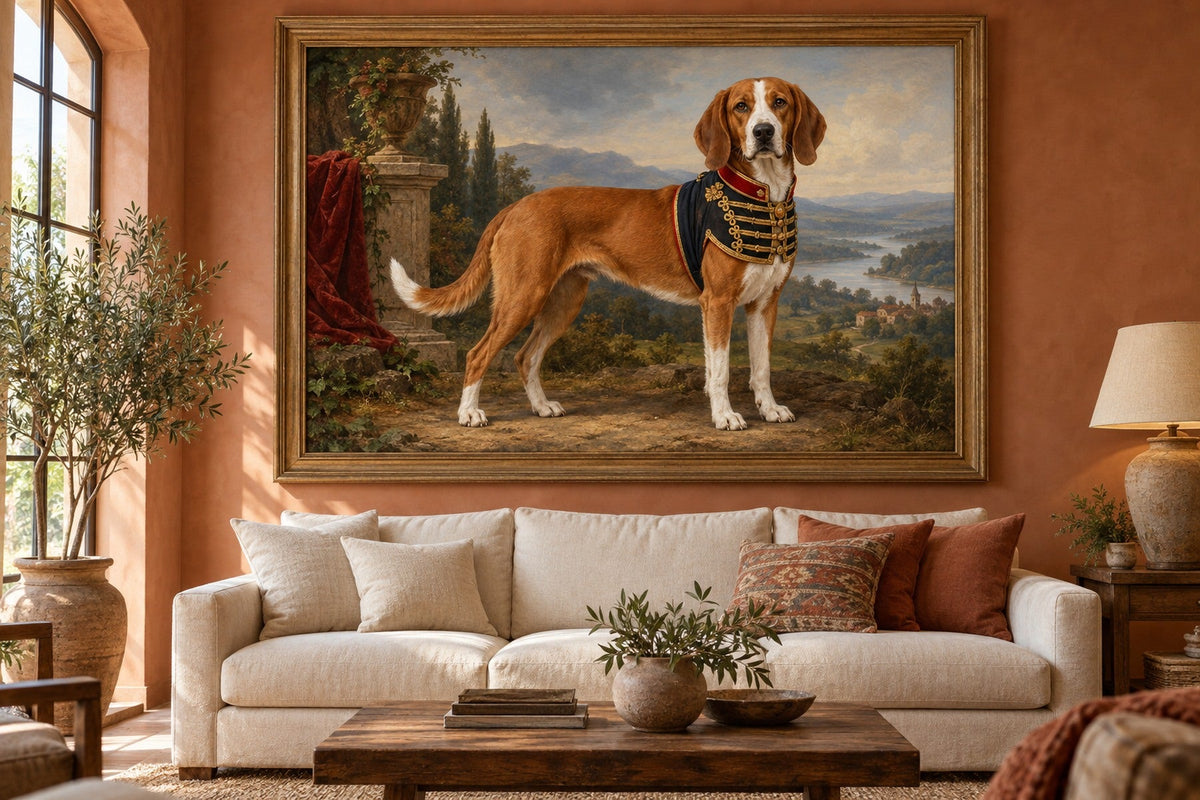
White has fixed places on the Posavatz Hound (Posavski Gonič): a blaze on the head, a collar around the neck, a patch on the forechest, a stripe on the belly, on the paws and at the tail tip. The FCI standard lists each location and considers a missing marking faulty. Everything else is reddish yellow, in any shade.
| FCI | Group 6 (Scent hounds and related breeds), Section 1.2 Medium-sized Hounds, Standard No. 154, with working trial |
|---|---|
| Country of origin | Croatia |
| Size (height at the withers) | males 50 to 56 cm, females 47 to 53 cm; 2 cm above or below tolerated in dogs of excellent type |
| Weight | not specified in the FCI standard |
| Life expectancy | no reliable study figure found (N/A) |
| Coat | harsh, dense, glossy and close-fitting, 2 to 3 cm; up to 4 cm on hind legs, belly and underside of tail |
| Colours in the standard | reddish yellow in all shades, with clear white markings on head, neck, forechest, belly, legs and tail tip, together no more than one third; never dark or chocolate brown, no white on ears |
The dog from the Sava Valley
The standard calls this the tracking hound of the Sava Valley and traces the breed to a red Illyrian hound with markings. The first depiction is considered to be a dark-yellowish, drop-eared dog in the 1474 painting of the Three Kings near Beram in Istria; the same image appears in the standard for the Istrian Short-haired Hound. Next come a 16th-century altarpiece in Veli Lošinj, Bishop Bakić’s manuscript of 1719 and a description by Franjo Bertić from 1854. An FCI standard has existed since April 1955.
An all-rounder with a melodic voice
The standard describes an easily trained, versatile hound who hunts in any terrain, giving tongue clearly and melodically. The desired dog is good-natured, neither fearful nor aggressive, appropriately lively and devoted to their person. These dogs hunt hare, fox and wild boar and also work as blood-tracking hounds.
What giving tongue means in daily life
A hound follows a trail independently and announces it with their voice. For your home, this means off-lead freedom in wildlife-rich terrain remains risky, and neighbours hear that lovely voice too. Tracking, mantrailing and long hikes on a long line provide activity. Hunting offers the most obvious task.
Short hair with a brush beneath the tail
The harsh, glossy hair is 2 to 3 cm long, slightly longer on the hind legs, belly and beneath the tail, where it forms a small brush. A weekly session with a rubber grooming mitt usually suffices. Check the close-hanging ears regularly.
What studies know
Very little. McMillan and colleagues’ longevity study names the breed but does not analyse it, and we found no disease studies. A study of 85 dogs from eight Balkan breeds measured copies of the starch-digestion gene AMY2B: the 13 Posavatz Hounds had the lowest value, averaging 10.8 copies, while the overall mean was 12.4 (Katica et al. 2025). The authors therefore place Balkan dogs on a par with other European breeds. This does not establish a feeding rule.
Who they suit and who they do not
They do well with hunters and people in the countryside who willingly provide daily scent work and want a friendly, uncomplicated dog. They are the wrong choice for first-time owners without a hunting connection, densely populated areas and long days alone. A similar dog with shaggy hair is the Bosnian Barak.

The breed quiz helps you assess whether your everyday life has room for a hound; our book “Which Dog REALLY Suits You?” (book in German) offers more detail. For the first weeks, there is the free Puppy Starter Pack. Capture reddish-yellow fur and that white blaze as digital artwork or a magazine cover on canvas.
Further reading
- Rice and potatoes with dog food: how to account for extras correctly
- Beagle: a nose with a dog attached, and what that means day to day
- Puppy biting: teaching bite inhibition without spoiling the fun
Sources, accessed on 20.10.2026: FCI Standard No. 154 Posavski Gonič (Savetalbracke, Posavatz-Bracke) (fci.be, German version dated 03.11.2016, English version dated 29.05.2015, valid original standard dated 03.11.2014); Katica J et al., Copy number variations in AMY2B gene and amylase activity in Balkan dog breeds, PLoS One 2025; McMillan KM et al., Longevity of companion dog breeds: those at risk from early death, Scientific Reports 2024 (breed listed but not analysed).
Links to our books are affiliate links. Buying through them supports us at no extra cost to you.


