

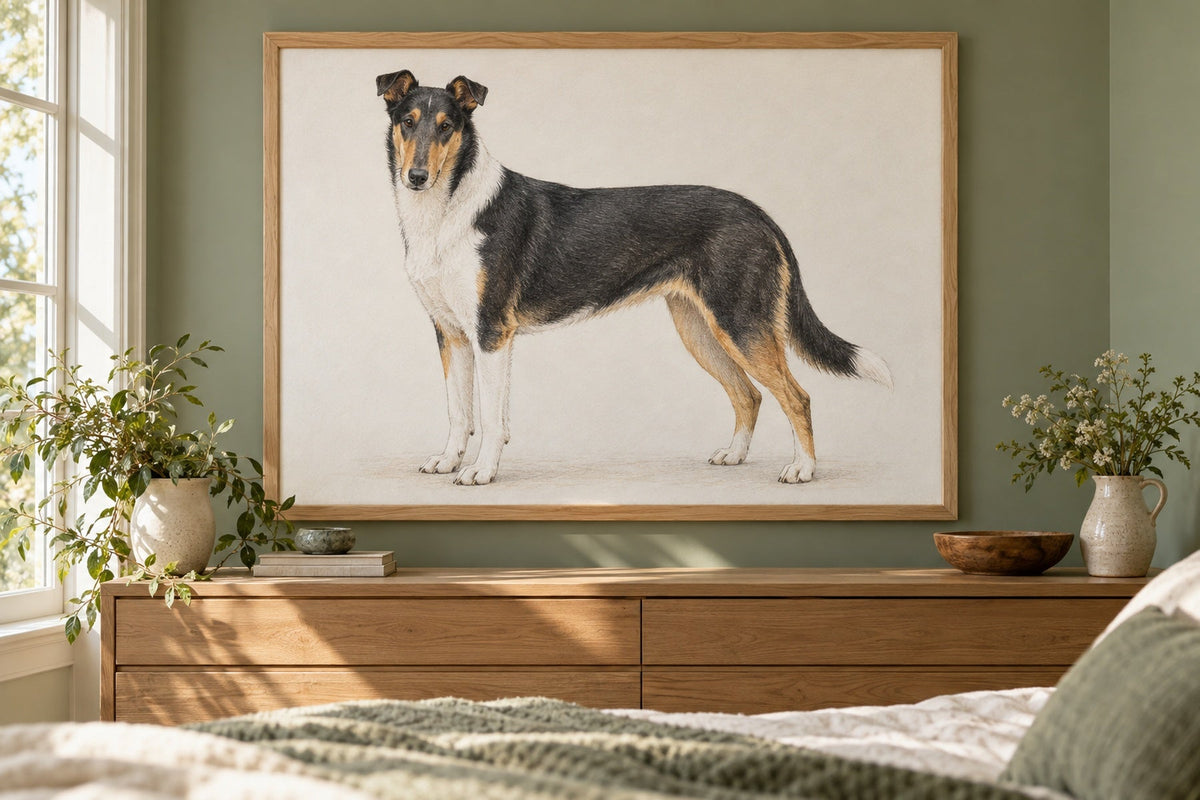
Rough and Smooth are the same Collie, differing only in coat length. So says the Rough Collie’s FCI standard, although the FCI treats them as separate breeds. With the Smooth Collie (Collie Smooth), more of the dog is visible: no mane hides neck, chest or the head’s clear wedge shape.
| FCI | Group 1 (Sheepdogs and Cattle Dogs), Section 1 Sheepdogs, Standard No. 296 Collie Smooth (Kurzhaariger Schottischer Schäferhund), without working trial |
|---|---|
| Country of origin | Great Britain |
| Height at the withers | Males 56 to 61 cm, females 51 to 56 cm |
| Weight | Males 20,5 to 29,5 kg, females 18 to 25 kg |
| Life expectancy | Median 13,3 years in a British analysis of 584.734 dogs, Smooth and Rough Collies combined (McMillan et al. 2024) |
| Coat | Short and flat, harsh outer coat, very dense undercoat; neither hand-stripped nor clipped |
| Colours according to the standard | Sable and white (pale gold to mahogany), tricolour (mainly black with tan), blue merle; typical white Collie markings, not beyond the withers; wholly or predominantly white highly undesirable |
A Collie without a mane
The Rough Collie (Collie Rough) standard tells the origins for both: the Romans probably brought dogs to Scotland, where they mixed with local types. Both Collies share the same foundation stock and continue to share lines. The Smooth has had separate definitive recognition since 18.12.1974 and a standard simply identifying a sheepdog.
Gentle expression, alert mind
The standard requires a friendly disposition without nervousness or aggression, and an intelligent expression with a quick, alert look when listening. Sensitive and closely cooperative with their people, these dogs respond better to calm than pressure.
Exercise with purpose
Movement should look light and effortless, with long strides: the dog is built for distance. Long walks, obedience, tracking or herding training bring satisfaction.
Short coat, dense wool
Shorter does not mean maintenance-free. Very dense undercoat lies beneath the harsh outer coat, coming out in clumps during shedding. A thorough weekly brush, more during shedding, keeps things manageable.
MDR1, eyes and encouraging hip results
MDR1 testing matters. Washington State University says around 70 per cent of US Collies carry the gene change; a German investigation of 7.378 dogs found the variant’s frequency in Collies at 59 per cent (Gramer et al. 2011), without separating coat lengths. Affected dogs tolerate some common medicines poorly, so the result belongs in the veterinary record. Collie eye anomaly also has a genetic test: commercial laboratory data showed frequencies falling in Smooth Collies from 2005 to 2015, while rising in Rough Collies (Clark et al. 2023). Encouraging Swedish results found hip dysplasia in 2,0 per cent of 348 X-rayed Smooth Collies, compared with 14,5 per cent of 2.076 Rough Collies (Engdahl et al. 2026).
A good home with
Families and active people seeking a friendly dog eager to learn, who enjoy outdoor training and want a Collie without a demanding mane.
Less happy with
People often away alone, using loud, impatient training or expecting contentment without shared activities.

To see whether a herding dog of this size fits your everyday life, try the breed quiz, or explore the question further in our book “Welcher Hund passt WIRKLICH zu dir?” (book in German). For starting life with a puppy, there is the free Puppy Starter Pack. The clear head shape stands out among our dog portraits, for example as a magazine cover on canvas.
Further reading
- Australian Shepherd: what MDR1 and merle mean for you
- Border Collie: when the cleverest dog has no job
- Autumn shedding in dogs and cats: what is normal and what is not
Sources, accessed on 20.10.2026: FCI-Standard Nr. 296 Collie Smooth (fci.be, English version dated 06.10.2026; no German version has been published); FCI-Standard Nr. 156 Collie Rough (fci.be, English version dated 06.10.2026); Washington State University, College of Veterinary Medicine, Washington Animal Disease Diagnostic Laboratory: Dog breeds commonly affected by MDR1 mutation (waddl.vetmed.wsu.edu); Gramer I et al., Breed distribution of the nt230(del4) MDR1 mutation in dogs, Veterinary Journal 2011; Clark JA et al., Global frequency analyses of canine progressive rod-cone degeneration-progressive retinal atrophy and collie eye anomaly using commercial genetic testing data, Genes 2023; Engdahl K et al., Prevalence of hip and elbow dysplasia in young adult dogs in Sweden, Veterinary Record 2026; McMillan KM et al., Longevity of companion dog breeds: those at risk from early death, Scientific Reports 2024.
The links to our books are affiliate links. Buying through them supports us at no extra cost to you.


